When a Simple Calculator Project Challenged the Way Electronics Were Built
In the late 1960s, electronic calculators were becoming increasingly sophisticated. Customers wanted machines that could do more than simple arithmetic. Features such as memory storage, printing capability, programmable operations, and better user interfaces were quickly becoming standard expectations rather than premium additions.
For engineers, however, every new feature created a new challenge.
Adding functionality wasn’t as simple as writing a few extra lines of code. In fact, there was no software to update. Every new feature had to be built directly into the hardware. A calculator with more capabilities usually meant designing more integrated circuits, each dedicated to a specific task.
It was an engineering approach that had served the industry well for years—but it came at a price. Every new product demanded a fresh collection of custom chips, increasing development time, manufacturing cost, and design complexity.
One company was about to experience this challenge firsthand.
A Calculator Unlike Any Before
Busicom, a Japanese manufacturer of desktop calculators, had ambitious plans for its next generation of machines.
Competition in the calculator market was becoming increasingly intense. Manufacturers were racing to introduce products that were faster, more capable, and easier to use. To stay ahead, Busicom envisioned a programmable desktop calculator that offered significantly more functionality than many of its competitors.
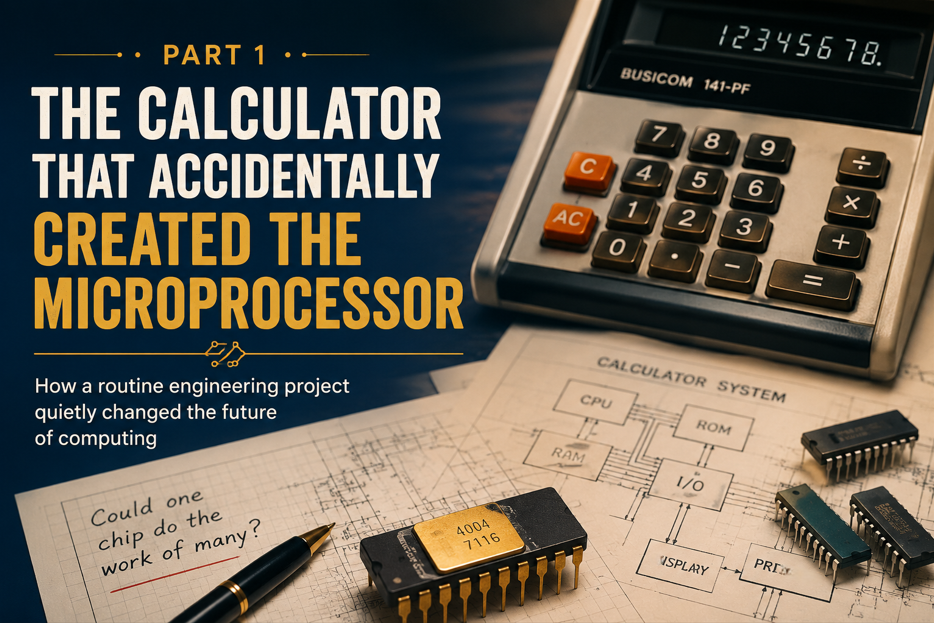
Busicom’s engineers developed an architecture that relied on approximately twelve custom integrated circuits. Each chip had a clearly defined responsibility. One handled arithmetic operations. Another managed memory. Others controlled the keyboard, display, printer, and the overall coordination of the system.
From an engineering perspective, the design made perfect sense. Each chip performed one job, and together they would deliver the functionality Busicom was aiming for.
But there was one major obstacle. Someone had to design and manufacture all those chips.
A Young Semiconductor Company Gets an Opportunity
That search led Busicom to a young American semiconductor company called Intel.
Founded in 1968 by Robert Noyce and Gordon Moore, Intel was still in its infancy. The company had built its early reputation by developing semiconductor memory devices, particularly SRAM and DRAM chips. Designing complex logic processors wasn’t yet part of its identity.
Nevertheless, Busicom’s proposal represented an attractive opportunity.
Winning the project would not only generate business but also demonstrate Intel’s capability to design sophisticated integrated circuits beyond memory products.
The proposal eventually reached Intel’s engineering team. At first glance, the assignment appeared straightforward. Busicom had already defined what each chip needed to do. Intel had to turn those specifications into silicon. No one imagined that the project would become anything more than another custom design contract.
Looking Beyond the Specification
Among the engineers reviewing the proposal was Marcian Edward Hoff Jr., better known as Ted Hoff.
Like everyone else on the team, Hoff received the design documents describing Busicom’s calculator chipset. The objective seemed clear enough: develop the custom integrated circuits exactly as specified.
But as Hoff studied the architecture, something continued to catch his attention. The design itself wasn’t flawed. In fact, it was carefully planned. Every chip had a well-defined purpose, and together they formed a complete calculator system. Yet the more he examined the schematics, the more he felt they reflected a much larger problem. Every new feature in the calculator required another dedicated chip. Every improvement increased hardware complexity. Every future calculator would likely require another complete redesign.
The design solved the immediate problem. It didn’t solve the long-term one.
An Industry-Wide Pattern
What Hoff was seeing wasn’t unique to Busicom. It was happening across the electronics industry.
Whether engineers were designing calculators, industrial controllers, communication equipment, or measuring instruments, the development process followed a familiar pattern.
First, define the product. Then design custom logic specifically for that product. When the next product arrived, much of the process had to be repeated.
As electronic systems became more sophisticated, the number of custom chips continued to grow. More chips meant more circuit boards. More circuit boards meant more connections. More connections increased manufacturing complexity, reduced reliability, and raised production costs.
The approach wasn’t wrong. It simply wasn’t scaling very well.
The semiconductor industry had reached a point where building more capable products required disproportionately more hardware.
A Different Question
Most engineers looking at Busicom’s proposal focused on the same objective. How can these twelve custom chips be designed as efficiently as possible?
Ted Hoff found himself thinking about a different question altogether. Instead of asking how Intel could build the twelve chips, he began wondering why the calculator needed twelve chips in the first place.
Could several of those functions be combined? Could the overall architecture be simplified? More importantly, was there a way to design one piece of hardware that could perform different tasks simply by following a sequence of instructions?
At first, it was only an idea. There were no circuit diagrams. No detailed architecture. No transistor-level implementation.
Just a simple question that challenged the conventional approach to electronic design.
It would soon become the foundation for something far bigger than a calculator.
In Part 2, we’ll see how that simple question evolved into a completely new way of designing electronic systems, and how the idea of a programmable central processor slowly began to take shape.
Discover more from VLSIFacts
Subscribe to get the latest posts sent to your email.