- ✅ Part 1 – The Problem
- ✅ Part 2 – The Idea
- ✅ Part 3 – The Implementation
- 📍 Part 4 – The Revolution
From a Calculator Chip to a Computing Revolution
By the end of Part 3, Intel had achieved something many believed was impossible—a complete programmable CPU on a single chip. The engineering challenge had been conquered. What remained was a far more unpredictable journey: how a processor designed for one calculator quietly sparked a revolution that would reshape the entire electronics industry.
When the Intel 4004 was introduced, no one predicted that it would redefine the future of computing. To most people, it was simply another integrated circuit—a component designed for electronic equipment.
Its original purpose hadn’t changed. It was still intended to help power Busicom’s calculators.
But history often has a way of assigning much larger roles to inventions than their creators ever imagined.
A Business Decision That Changed Everything
One of the least discussed parts of the Intel 4004 story wasn’t technical at all. It was commercial.
Since Busicom had commissioned the project, the processor had initially been developed specifically for their calculator system. Under normal circumstances, it could have remained just another custom chip used in a single product family.
If that had happened, the Intel 4004 might have become little more than a footnote in semiconductor history.
Instead, an important business decision changed its future.
Amid a softening desktop calculator market in May 1971, Busicom faced severe cash-flow constraints. To sustain operations, the Japanese firm requested that Intel reduce the unit manufacturing price of its newly developed, multi-chip MCS-4 custom silicon logic set.
Intel CEO Robert Noyce countered with a historic compromise: Intel would grant the price cuts and fully refund Busicom’s initial $60,000 non-recurring engineering (NRE) investment. In return, Busicom relinquished exclusivity, surrendering all intellectual property rights to market the design for non-calculator applications.
It was a decision that would prove far more significant than anyone involved could have anticipated.
For the first time, engineers outside Busicom could purchase a programmable processor and build entirely different products around it.
The microprocessor was no longer tied to a single calculator. It had become a commercial building block.
“Announcing a New Era in Integrated Electronics”
In November 1971, Intel introduced the MCS-4 family to the world.
The advertisement was strikingly confident. Its headline read:
“Announcing a new era in integrated electronics.”
Looking back today, the statement feels remarkably accurate.
At the time, however, very few people appreciated what Intel had actually accomplished. The semiconductor industry largely viewed the 4004 as an innovative controller for calculators and similar electronic systems.
Few imagined that programmable processors would eventually become the heart of almost every electronic device.
History would prove much more ambitious than anyone’s expectations.
The Idea Was Bigger Than the Chip
The Intel 4004 was never designed to power personal computers. It wasn’t powerful enough.
Its 4-bit architecture made it well suited for calculators and control applications, but far too limited for the computing systems that would emerge in the following decades.
Yet the processor had already demonstrated something far more important than performance. It proved that an entire central processing unit could exist on a single integrated circuit.
That single achievement changed the direction of semiconductor design.
Once engineers knew it could be done, the next question became obvious.
How much more powerful could it become?
Intel answered that question remarkably quickly.
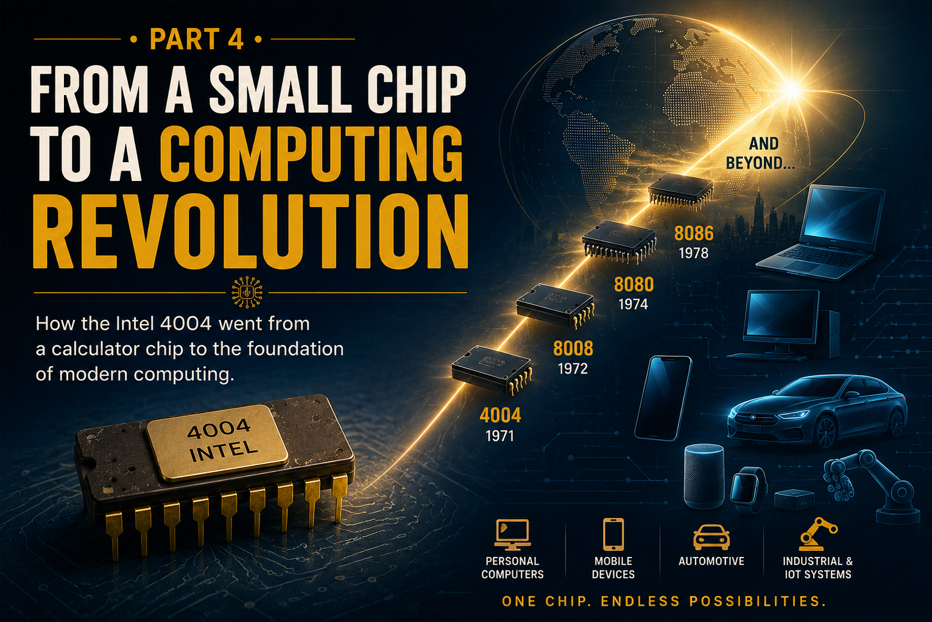
In 1972, came the Intel 8008, the world’s first 8-bit programmable microprocessor.
Two years later came the Intel 8080, a processor that would power some of the earliest personal computers.
Then, in 1978, Intel introduced the 8086, the processor that established the x86 architecture—a design lineage that continues to influence desktop and server processors more than four decades later.
Each new processor is built upon the foundation laid by the Intel 4004.
The architecture evolved. The transistor counts increased. Clock frequencies climbed dramatically. But the underlying idea remained the same. A programmable processor at the center of an electronic system.
Changing More Than Computers
The Intel 4004 didn’t just change processor design. It changed the economics of electronics.
Before programmable processors became practical, manufacturers often had to redesign hardware whenever they wanted to introduce new functionality.
The microprocessor fundamentally altered that relationship. Instead of redesigning the hardware, engineers could increasingly solve problems through software.
The same processor could be used in different products. Only the program changed. That simple shift transformed product development.
Electronic systems became more flexible. Development cycles became shorter. Manufacturing costs could be reduced. Products became easier to upgrade and adapt for different applications.
What began as an improvement in chip architecture gradually reshaped entire industries.
The Legacy Lives Everywhere
Today, billions of processors are manufactured every year.
They power smartphones, laptops, automobiles, medical equipment, industrial robots, satellites, home appliances, and countless embedded systems that most people never notice.
Modern processors bear little resemblance to the Intel 4004 in terms of speed, complexity, or transistor count.
The comparison is almost impossible.
The 4004 contained approximately 2,300 transistors. Today’s high-performance processors contain tens of billions.
Yet every modern processor shares one important piece of DNA with that small 4-bit chip introduced in 1971.
The idea that computing could be condensed into a programmable processor built on a single piece of silicon.
That idea continues to define the digital world.
More Than an Invention
The story of the Intel 4004 is often described as the invention of the first commercially available microprocessor.
That description is accurate.
But it isn’t the whole story.
It is also a story about engineers who questioned accepted practices.
It is a story about simplifying complexity instead of accepting it.
It is a story about collaboration between people with different expertise—Ted Hoff, Federico Faggin, Stanley Mazor, and Masatoshi Shima—each contributing something essential to the final outcome.
Most importantly, it reminds us that transformative technologies don’t always begin with a vision to change the world.
The Intel 4004 wasn’t the most powerful processor ever built. It wasn’t even designed to change the world. Yet more than fifty years later, every modern CPU—from the microcontroller inside a smartwatch to the processors powering artificial intelligence—can trace its origins back to one small calculator project that challenged how electronics were built.
Discover more from VLSIFacts
Subscribe to get the latest posts sent to your email.