- ✅ Part 1 – The Problem
- ✅ Part 2 – The Idea
- 📍 Part 3 – The Implementation
- ⏳ Part 4 – The Revolution
Turning an Idea into Silicon
As we read in Part 2, by the beginning of 1970, Intel had something valuable. It had an idea.
The proposed architecture promised to replace a complex collection of custom chips with a much simpler programmable system. On paper, the concept looked elegant. It reduced hardware complexity while giving the calculator far greater flexibility.
But an elegant idea on paper doesn’t automatically become a successful integrated circuit.
Someone still had to build it. And that was no ordinary task.
A New Engineer Joins the Project
In April 1970, an Italian engineer named Federico Faggin joined Intel.
Before arriving at Intel, Faggin had already established himself as one of the industry’s most talented integrated circuit designers. While working at Fairchild Semiconductor, he had played a key role in developing silicon-gate MOS technology, a manufacturing process that allowed transistors to be made faster, smaller, and more reliable than earlier metal-gate technologies.
Intel recognized that expertise immediately.
Soon after joining the company, Faggin was assigned responsibility for turning the proposed processor architecture into a real product.
It would become one of the defining projects of his career.
Implementing a Processor Was Very Different from Imagining One
Today, chip designers work with an extraordinary collection of software tools. Hardware description languages describe digital logic. Simulation software verifies functionality before fabrication. Place-and-route tools automatically position millions of standard cells. Static timing analysis predicts timing violations long before silicon is manufactured. Artificial intelligence is increasingly assisting engineers in optimizing complex designs.
None of those tools existed in 1970. Designing an integrated circuit demanded a completely different approach. Engineers manually created transistor-level circuits. Layouts were drawn by hand. Timing relationships were calculated with remarkable care. Every transistor placement required careful consideration because changing it later was neither quick nor easy. Mistakes weren’t corrected with a few mouse clicks. They often meant redesigning significant portions of the chip.
Building a processor under those conditions required not only technical knowledge but also extraordinary patience and attention to detail.
More Than One Engineer Was Shaping the Processor
Although Federico Faggin led the implementation effort, the project remained highly collaborative. Each engineer brought a different perspective.
Hoff focused on simplifying the overall architecture.
Mazor concentrated on the processor’s instruction set architecture and logical organization.
Shima ensured the system met the calculator’s functional requirements.
Faggin transformed those ideas into working silicon.
The Intel 4004 was not the achievement of one individual. It was the result of several engineers solving different pieces of the same engineering challenge.
Making Thousands of Transistors Work Together
By modern standards, the Intel 4004 appears remarkably simple. The chip was built using a 10-micron process and measured 12 square millimeters. It contained approximately 2,300 transistors.
Today’s smartphone processors contain tens of billions of transistors. Even inexpensive microcontrollers now include far more transistors than the entire 4004.
Yet those comparisons can be misleading. In 1970, integrating more than two thousand transistors into a single reliable integrated circuit represented a significant engineering accomplishment. Every transistor had a purpose. Every connection had to function correctly.
The processor had to fetch instructions from memory, decode them, perform arithmetic operations, communicate with external devices, and repeat the process continuously without error.
If even a small portion of the design failed, the entire processor would fail. Achieving that level of reliability was one of the project’s greatest technical challenges.
A New Family of Integrated Circuits
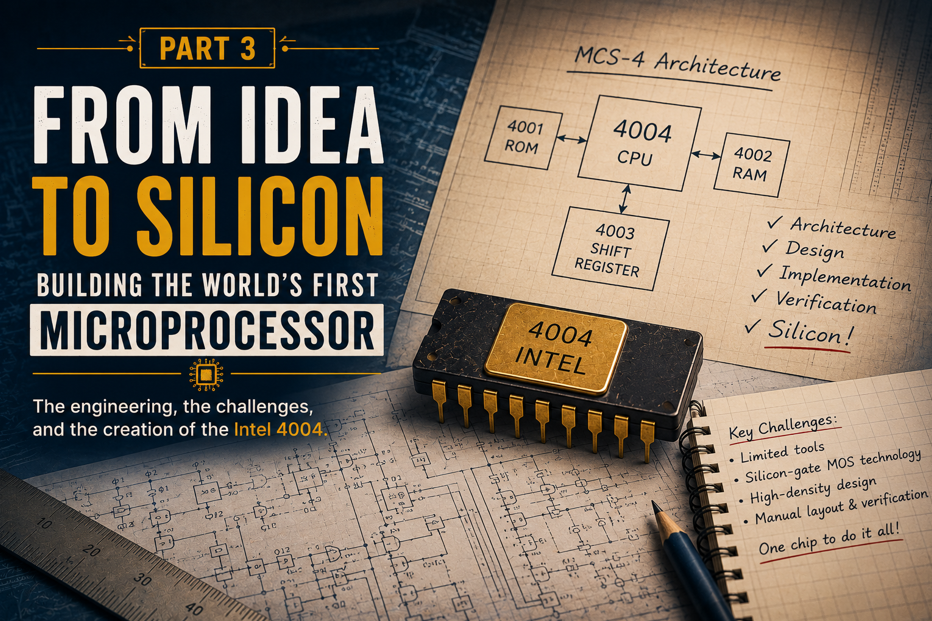
As development progressed, the processor became part of a small family of integrated circuits designed to work together. Intel called the family MCS-4. It consisted of four primary devices:
- Intel 4004, the central processing unit.
- Intel 4001, a read-only memory that stored the program.
- Intel 4002, a random-access memory used for data storage.
- Intel 4003, a shift register that expanded input and output capability.
Each chip had a specific role. Together, they formed a complete computing system.
Although the processor received most of the attention, the surrounding support chips were equally important. Without them, the CPU alone could accomplish very little.
The MCS-4 chipset demonstrated that a programmable electronic system no longer required dozens of custom integrated circuits.
A small, carefully designed collection of chips could achieve the same objective with far greater flexibility.
A Historic Milestone
After months of design, testing, and refinement, the processor was finally ready.
In November 1971, Intel officially introduced the Intel 4004.
From a technical perspective, it was a modest processor. It was a 4-bit CPU operating at a clock frequency of approximately 740 kHz and capable of executing around 92,000 instructions per second.
Those numbers seem insignificant today. Even the simplest embedded processors available now outperform it by several orders of magnitude. Yet measuring the Intel 4004 by modern performance standards completely misses its significance.
The real breakthrough wasn’t how fast it was. It was what it proved.
For the first time, an entire central processing unit had been successfully integrated onto a single commercially available chip. That achievement fundamentally changed the direction of semiconductor engineering.
The microprocessor had arrived.
Part 4 explores how a processor designed for a calculator escaped its original purpose, became a commercial product, and laid the foundation for the modern computing revolution.
Discover more from VLSIFacts
Subscribe to get the latest posts sent to your email.