A small-town Iowa boy, caught red-handed stealing a pig for a college prank, goes on to shape the modern world as the co-inventor of the microchip. This is the story of Robert Noyce, the man dubbed the “Mayor of Silicon Valley.” His life is a whirlwind of brilliance, rebellion, and innovation that transformed Silicon Valley into the tech mecca we know today. Buckle up for a tale that’s equal parts heartwarming, rebellious, and revolutionary—because Noyce’s journey is anything but ordinary.
Early Years: A Curious Kid with Big Dreams
Born on December 12, 1927, in Burlington, Iowa, Robert Noyce grew up in the quiet town of Grinnell, where his father was a Congregational minister. Young Bob was a tinkerer from the start, building radios and model airplanes in his family’s basement. At age 12, he and his brother constructed a makeshift glider, launching it off a barn roof. His childhood was a blend of small-town simplicity and insatiable curiosity, setting the stage for a mind that would later rewire the world.
At age 5, young Bob Noyce stunned his family by beating his father at ping‑pong – and refused to let him win out of politeness. “That’s not the game,” little Bob sulked. “If you’re going to play, play to win!”
The Pig Prank: A College Misadventure
Noyce’s brilliance didn’t always keep him out of trouble. While attending Grinnell College, he pulled off a stunt that nearly derailed his future. In 1948, during his senior year, Noyce and a friend, fueled by youthful mischief, stole a pig from a local farmer for a campus luau. The prank backfired spectacularly when the farmer pressed charges.
The stunt got him a one-semester suspension, but instead of facing permanent expulsion, he impressed the college’s president with his honesty and intelligence. This episode wasn’t just a juvenile prank; it showed the rebellious streak that would later become part of his entrepreneurial DNA – a man willing to challenge authority and take bold, unconventional steps.
“He didn’t have the arrogance of a rule-breaker, but he had the curiosity of a builder,” said a former colleague at Intel.
Education: From Grinnell to MIT
Despite the pig fiasco, Noyce excelled at Grinnell College, graduating in 1949 with a degree in physics and mathematics. His professors saw his potential early, with one recommending him to MIT for graduate studies – a rare feat for a small-town kid. At MIT, Noyce earned his Ph.D. in physics in 1953, diving deep into the world of transistors. His doctoral work on semiconductor physics laid the groundwork for his later breakthroughs. MIT wasn’t just a stepping stone; it was where Noyce honed the technical prowess that would redefine technology.
At MIT, classmates nicknamed him “Rapid Robert” due to his sharp mind and ability to quickly grasp and solve complex problems.
Career Beginnings: From Shockley to Fairchild
Noyce’s career kicked off at Philco Corporation, but the real turning point came in 1956 when he joined William Shockley’s Semiconductor Laboratory in Mountain View, California. Shockley, a Nobel laureate, was a pioneer in transistor technology, but his abrasive management style clashed with Noyce’s collaborative spirit. Frustrated, Noyce and seven colleagues—later dubbed the “Traitorous Eight”, left Shockley in 1957 to found Fairchild Semiconductor. This move was monumental. It laid the groundwork for the birth of Silicon Valley’s startup culture – a culture where engineers became entrepreneurs and ideas turned into billion-dollar businesses.
Arriving in Palo Alto at 6 a.m., by noon Bob had purchased a house – and that afternoon he walked into Shockley Semiconductor Labs and asked for a job, which he got. This anecdote highlights Noyce’s decisive and proactive nature in pursuing his career goals.
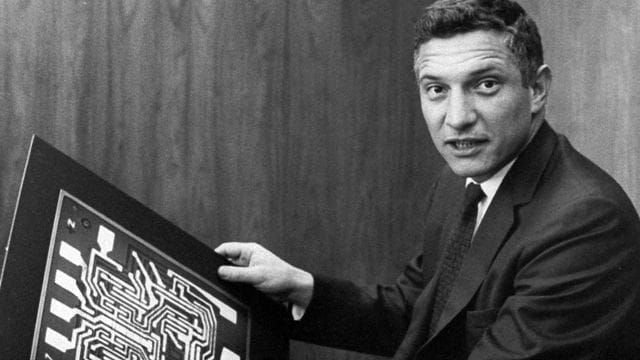
At Fairchild, Noyce’s genius shone. In 1959, he co-invented the integrated circuit (IC), a tiny chip that could house multiple transistors, revolutionizing electronics. While Texas Instruments’ Jack Kilby also developed a similar concept, Noyce’s design was more practical for mass production, earning him a lasting legacy. The IC became the backbone of modern computing, powering everything from calculators to spacecraft. Fairchild’s success laid the foundation for Silicon Valley’s rise as a tech hub, and Noyce’s leadership earned him the “Mayor” moniker.
Building Intel: The Birth of a Tech Giant
By 1968, Noyce was ready for his next big move. Teaming up with Gordon Moore (of Moore’s Law fame) and Andy Grove, he co-founded Intel Corporation. Their goal was simple but ambitious: to produce high-performance semiconductor memory and logic chips. Under Noyce’s leadership, Intel developed the 4004, the world’s first commercially available microprocessor, in 1971. This tiny chip, smaller than a fingernail, packed the power of a room-sized computer and changed the world forever.
Noyce’s management style was as innovative as his inventions. He fostered a culture of openness at Intel, ditching formal titles and encouraging engineers to speak freely. Employees recall him wandering the halls in sneakers, chatting with everyone from interns to executives. His charisma and vision made Intel a breeding ground for innovation, cementing its status as a Silicon Valley powerhouse.
The Mayor’s Legacy: More Than Just Microchips
Noyce’s impact went beyond technology. As a mentor, he inspired a generation of entrepreneurs, including Steve Jobs, who called Noyce a “national treasure.” He championed collaboration, helping establish the Semiconductor Industry Association to protect U.S. tech interests. His philanthropy, including donations to Grinnell College, reflected his commitment to giving back.
Tragically, Noyce’s life was cut short in 1990 when he died of a heart attack at age 62. Yet his legacy endures in every smartphone, laptop, and device powered by a microchip. Silicon Valley, as we know it, owes much to the Iowa boy who dared to dream big.
Robert Noyce wasn’t just a tech pioneer; he was a visionary who blended brilliance with humanity. From his mischievous childhood to his groundbreaking work at Fairchild and Intel, he built the foundation of our digital age. The “Mayor of Silicon Valley” title isn’t just a nickname – it’s a testament to a man who turned a sleepy valley into a global tech epicenter. So, next time you pick up your phone, spare a thought for Noyce, the pig-stealing, world-changing genius who made it all possible.
Discover more from VLSIFacts
Subscribe to get the latest posts sent to your email.